Benefits of Knowledge Management: How Smarter Information Sharing Drives Business Success
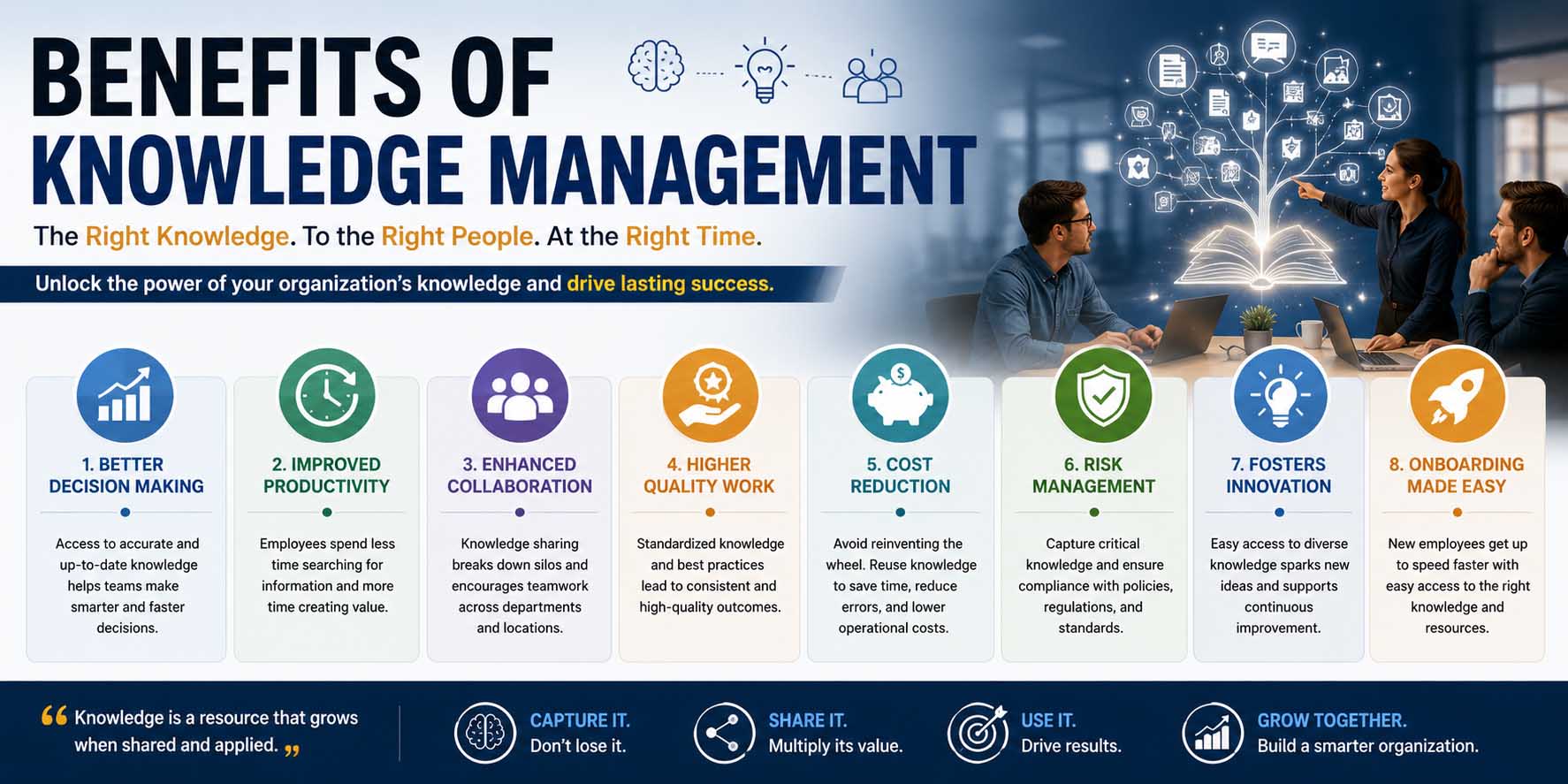
Every business creates valuable knowledge every day, from customer insights and project lessons to operating procedures and technical expertise. The challenge isn’t generating information—it’s making sure employees can find and use it when they need it. That’s why understanding the benefits of knowledge management has become essential for organizations that want to improve efficiency, reduce mistakes, and stay competitive.
A strong knowledge management approach helps businesses capture, organize, and share information across teams. Instead of valuable expertise disappearing when employees leave or projects end, that knowledge becomes a long-term business asset that supports growth and better decision-making.
What Is Knowledge Management?
Knowledge management is the process of collecting, organizing, storing, sharing, and maintaining information so employees can easily access it.
This information may include:
- Company policies
- Training materials
- Standard operating procedures
- Customer support documentation
- Project reports
- Best practices
- Lessons learned
- Technical documentation
Rather than keeping information in scattered emails or individual computers, businesses create systems that make knowledge accessible to everyone who needs it.
Many organizations use What Is Productivity Software alongside their knowledge management tools to make collaboration, document sharing, and daily work more efficient.
Benefits of Knowledge Management for Modern Businesses
The benefits of knowledge management extend far beyond document storage. When implemented well, it improves almost every area of an organization.
Faster Access to Information
Employees spend less time searching for files, answers, or procedures.
Instead of asking coworkers the same questions repeatedly, they can quickly find documented information through a centralized knowledge base.
This saves hours each week across the organization.
Better Decision-Making
Managers make stronger decisions when accurate information is easy to access.
Historical project data, customer feedback, performance reports, and documented best practices provide valuable context before important business decisions are made.
Increased Productivity
Knowledge management reduces duplicate work.
Teams can reuse proven templates, documented workflows, and successful processes instead of starting every task from scratch.
As a result, employees spend more time creating value and less time searching for answers.
Improved Collaboration
Departments often work more effectively when information flows freely.
Marketing, sales, operations, finance, and customer service can all access shared resources instead of working in isolated systems.
This creates better alignment across the business.
What Are the Benefits of Knowledge Management?
Many business leaders ask, what are the benefits of knowledge management beyond improving efficiency.
Some of the biggest long-term advantages include:
- Faster employee onboarding
- Better customer experiences
- Lower training costs
- Consistent work quality
- Reduced operational risk
- Higher employee confidence
- Improved innovation
- Stronger organizational learning
- Better compliance with company procedures
These benefits become even more valuable as organizations grow and teams become more distributed.
How Knowledge Management Supports Business Growth
Growth often creates new challenges.
More employees mean more information, more processes, and more opportunities for communication gaps.
Knowledge management creates consistency by giving every employee access to the same trusted information.
This allows businesses to scale without losing operational quality.
Companies investing in the benefits of digital transformation often discover that effective knowledge management becomes one of the foundations of their broader technology strategy.
Benefits of Knowledge Management System
A dedicated platform provides much more than document storage.
The benefits of knowledge management system include:
Centralized Information
Employees no longer need to search through emails, shared drives, or chat conversations.
Everything lives in one searchable location.
Version Control
Current procedures remain easy to identify.
Employees avoid using outdated forms or obsolete instructions.
Better Security
Access permissions ensure sensitive information remains available only to authorized users.
Easier Remote Collaboration
Hybrid and remote teams can work efficiently regardless of location.
Everyone accesses the same resources without relying on physical office files.
Benefits of a Knowledge Management System for Employees
The benefits of a knowledge management system become especially noticeable during everyday work.
Employees gain:
- Faster answers
- Clearer processes
- Better training resources
- Less dependence on individual coworkers
- Greater confidence when completing tasks
New hires also become productive much faster because onboarding materials are organized and easy to access.
Real-World Example
Imagine a growing software company with 120 employees.
Before introducing knowledge management:
- Customer service repeatedly answered the same internal questions.
- Developers documented projects differently.
- Sales teams struggled to find updated pricing information.
- New employees relied heavily on experienced coworkers.
After implementing a centralized knowledge platform:
- Support response times improved.
- Employee training became faster.
- Documentation remained consistent.
- Teams collaborated more effectively.
Small improvements across multiple departments combined to create significant productivity gains.
Building an Effective Knowledge Management Strategy
Technology alone isn’t enough.
Businesses also need clear processes.
An effective strategy usually includes:
Capture Knowledge
Document important information as work happens.
Encourage employees to record solutions, lessons learned, and successful workflows.
Organize Content
Create logical categories and naming conventions.
Well-organized information is much easier to find later.
Keep Information Updated
Assign ownership for important documents.
Outdated knowledge can be almost as harmful as missing knowledge.
Encourage Sharing
Reward collaboration rather than information hoarding.
Employees should feel comfortable contributing ideas and improvements.
Knowledge Management Across the Product Development Process
Knowledge management plays an important role throughout the Product Development Life Cycle by preserving customer feedback, design decisions, testing results, and project documentation for future product improvements.
Without organized knowledge, valuable lessons from previous projects are often lost.
Common Knowledge Management Tools
Organizations use a variety of platforms depending on their size and needs.
Popular categories include:
- Internal knowledge bases
- Document management systems
- Company wikis
- Collaboration software
- Learning management systems
- Project documentation platforms
- Customer support knowledge bases
The best solution depends on company size, workflows, and security requirements.
Common Challenges
Knowledge management isn’t without obstacles.
Businesses often struggle with:
- Employees resisting documentation
- Outdated content
- Poor search functionality
- Duplicate information
- Lack of ownership
- Limited executive support
Fortunately, these issues can be reduced through clear governance and regular maintenance.
Best Practices for Long-Term Success
Organizations with successful knowledge management programs typically follow several best practices.
Keep Documentation Simple
Write instructions clearly.
Avoid unnecessary jargon whenever possible.
Update Regularly
Review important resources every few months to ensure accuracy.
Make Search Easy
Employees should locate information quickly using keywords, categories, or filters.
Train Employees
Teach teams how to contribute and maintain knowledge, not just how to consume it.
Measure Results
Track metrics such as:
- Search success rate
- Employee adoption
- Time saved
- Training completion
- Support ticket reduction
These measurements help demonstrate business value.
Leadership’s Role in Knowledge Sharing
Managers influence whether knowledge sharing becomes part of company culture.
Leaders should:
- Document their own processes.
- Encourage collaboration.
- Recognize employees who contribute valuable resources.
- Remove barriers that discourage information sharing.
When leadership actively participates, employees are much more likely to adopt knowledge management practices.
Organizations working with IT Strategy Consulting firms often include knowledge management initiatives as part of larger plans for improving technology, collaboration, and operational efficiency.
How Knowledge Management Supports IT and Operations
Technology teams rely heavily on documented processes.
System configurations, troubleshooting guides, cybersecurity procedures, and software documentation become much easier to maintain through structured knowledge management.
Businesses already experiencing the benefits of managed IT services often strengthen those results by pairing reliable IT infrastructure with well-organized internal knowledge resources.
Together, they reduce downtime and improve operational consistency.
Common Mistakes to Avoid
Many businesses invest in software without changing their processes.
Avoid these mistakes:
- Treating knowledge management as an IT project only
- Failing to assign content owners
- Ignoring employee feedback
- Allowing outdated documents to remain available
- Creating overly complex documentation
- Measuring activity instead of business outcomes
The goal isn’t simply storing information—it’s making knowledge useful.
Benefits of a Good Knowledge Management Strategy
The benefits of a good knowledge management strategy become even more valuable over time because information continues to accumulate instead of disappearing.
Organizations with mature knowledge management practices often experience:
| Benefit | Business Impact |
|---|---|
| Faster onboarding | Reduced training time |
| Better collaboration | Improved teamwork |
| Consistent processes | Fewer operational errors |
| Stronger innovation | Easier idea sharing |
| Better customer service | Faster problem resolution |
| Knowledge retention | Less dependence on individual employees |
| Improved scalability | Easier business growth |
Rather than relying on individual expertise, the organization develops a shared foundation that supports long-term success.
Frequently Asked Questions
What is knowledge management?
Knowledge management is the process of collecting, organizing, sharing, and maintaining business knowledge so employees can easily access and use it.
Why is knowledge management important?
It improves productivity, supports better decisions, reduces duplicate work, and helps preserve valuable organizational knowledge.
Who benefits from knowledge management?
Employees, managers, customers, and business owners all benefit from faster access to reliable information and more consistent processes.
Do small businesses need knowledge management?
Yes. Even small organizations can improve efficiency by documenting procedures, customer information, and business processes before growth makes information harder to manage.
Is knowledge management only about software?
No. Software helps organize information, but successful knowledge management also depends on company culture, leadership support, clear processes, and regular maintenance.
Turn Knowledge Into a Lasting Business Asset
The benefits of knowledge management go far beyond organizing documents. A well-designed system helps employees work more efficiently, supports smarter decisions, improves collaboration, and protects valuable business expertise from being lost over time.
Whether you’re running a startup or managing a large enterprise, investing in knowledge management creates long-term value. Start by documenting your most important processes, encourage employees to share what they learn, and choose tools that make information easy to find. Small improvements today can build a stronger, more resilient organization for years to come.